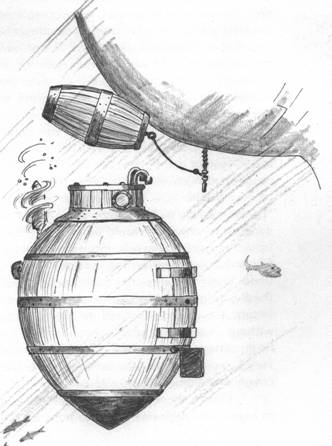
A submarine is an instrument developed from neccessity of war to sneak up on enemy
ships and do their best to sink them. As early as the American Revolution men
have been trying to develope ways to do this. Early devices were crude
at best. Not much more than a large barrell that floated just below the surface
of the water. One man inside with a crank mechanism which turned a propeller.
On September 7, 1776 David Bushnell ofConnecticutt attemted the first known submarine
attack on an enemy ship anchored in Upper New York Bay off Manhatten Is.
HMS Eagle was the target ship. Admiral Lord Howe, brother to General Howe who
later was defeated by Washington, was in command of the fleet.There had been rumors
of a man working on a strange craft but no one would have thought it to be
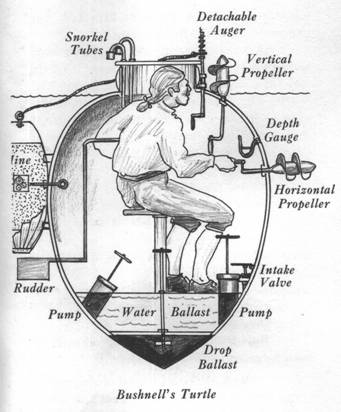
anything like this.It was i similar shape to a turtle and was called Bushnells
Turtle. It was crude looking by todays standards but Bushnell was a craftsman
and it was well engeneered with lathe turned shafts which were used to propel the
small vessel and seals to keep water from leaking in.Two tubes that were bent
downward and had a check vale in them were an early version of a snorkel. He
even had a glass window which to see thru. An auger was attatched with a barrell
of black powder and was ingeniously rigged to let loose when the auger drill
was released from the brace bit and a timer was started which gave an hour to get
away. He had a depth guage, rudder, two pumps for water ballast and a lead ballast
wich could be dropped if neccesary to aid in a quick return to the surface.
Once under water he had enough air for about thirty minutes. Bushnell had been
working on a theory to explode black powder underwater.He did get under the
British ship and did get an auger screwed partially into the hull but the auger
didn't hold and the attempt to sink the large British warship at anchor was unsuccessful.
There was a large explosion that rocked the big ship and threw water
high into the air but since the auger had apparently struck a heavey iron bar
connecting the rudder fitting to the sternpost. A few inches more and he would
most likely have been successful. |
asw anti-submarine warefare |
Feb 17th, 1864 a Confederate submarine named Hunley for it's designer was the first
submarine to sink an enemy vessel. After several tries three crews lost testing
it they finally got it working. On a daring raid it went out of Charlston harbor
and torpedoed the USS Housatonic which had been blockading Charlston Harbor.
On the return trip they held a lantern out of the scuttle to signal mission
accomplished. That was the last it was seen until it was raised on August 8, 2000.
Hunly proved the idea of underwater attacks would work. Since the beginning
of the war in 1861 both sides had been working on the idea of submarine
attacks. The Confederate H.L. Hunley and her brave crew proved it could be done.
Other countries bagan working with the idea of submarines. For years after the
war with a government that had become corrupt and neglected the military and
to a great degree the Navy. It wasn't until Teddt Roosevelt became Secretary of
the Navy did the US start to modernize it's navy. When Teddy became President
he did even more to give us a modern navy and bring it into the twentieth century.
The US no longer lagged behind Britain, Germany, Russia and Japan as well
as other countries in research and developement of the submarine. In 1898 the US
Navy commissioned the first submarine, Holland, named for it's developer and
builder. Holland would later become famous for engineering a long, curved underwater
tunnel that many said could never be built. The Holland Tunnel into New York
City. The Holland was still experimental but soon the navy hierarchy was sold on the idea of submarine warefare.Before the opening shots of WW I in 1914 the US would have a modern fleet of submarines. Modern by 1914 standards. |

Teddy Roosevelt was most reponsible for developing a modern navy for the still
young United States. In 1902 the US was not yet taken seriously by the world
powers. We were barley thought of of what today would be a second world nation
at best.For over 30 years after the War Between The States the US government
had seen fit to neglect the military. Some money had been appropriated by the
late 1880's for a few modern main line battle ships to replace an aged fleet of
sailing ships. Roosevelt pressed hard as Secretary of the Navy to get better safety
standards for the weaponry. Most navies were far advanced. US designs still
used an open ammo handling room which when the guns fired burning powder would
fall below and set off fires and explosions. Roosevelt was to change this and
set other standards that todays navy still follows. Besides modernizing the fleet he saw a need for smaller faster ships. Barely a ship, a new type was created. It became a whole different navy. The Tin Can was born.The destroyer was born in 1902 but not to hunt subs. This would come later. Germany was the first navy to use submarines to any extent to sink shipping and this was in 1914. Sonar was developed and first used by Great Britain in 1915 and destroyers took on a new role. At first these small DD were actually torpedo boat destroyers. Their role was to take torpedoes into the enemy ships and launch then come away. The other duty was to intercept torpedoes and take one for the big boys. Save the main fleet. They were used to lay smoke screens, a tactic long used to hide the fleet from view of enemy guns and range finders.They were also scouts that would steam out ahead of the main battle fleet and radio positions of enemy shipping.Submarine warefare changed that role but it wasn't until WW II that ASW became well perfected. Depth charge was the main effective weapon against subs. The DD tracked the sub then would go over the plotted course of the sub to drop charges over the target was suspected to be.. Our boys did get really good at this. This was close in attack. As technoligy changed the need for better weapons became neccesary. While depth charges were dropped from racks on the fantail as the ship crossed over the area where the sub was believed to be, there was another method of delivering the depth charge. K Guns were posts welded on the main deck along the sides and a special can was placed on it and shot out a few hunderd yards to where the target was thought to be. Destroyers had torpedoes too but they were for use against surface ships. It wouldn't be until the fifties that torpedoes were developed to be used against underwater targets.The destroyer was an all around fighting machine. It was equipped for not only ASW but also anti air and surface warefare as well. Destroyers were good for rescue duty too since they were smaller and the main deck was closer to the sea.Destroyers and the smaller Destroyer Escort were the GreyHounds of the sea. Small Boys they were called and in WW II they became the backbone of the navy. DD's and DE's proved themselves in battle. New naval battle tactics were developed and the role of the destroyer was greatly expanded from what was learned during the war. From going up against the Japs largest battleships and cruisers in the Surigao Straights or the Battle of Samar in the Phiilipines to relentlesly hunting and destroying enemy submarines.Gunfire support missions on virtually every island landing in the Pacific.In the Normandy Invasion they did their best to protect troops storming the beaches with their close in gunfire support. The D Day invasion of June 6. 1944 was the only time when land based tanks and ships at sea were actually in battle with each other. The Tin Cans were so close to the shore that German tanks were firing at them and losing the battle to the efficiency of naval gunfire. Tin Cans were used for everything and in every naval action of the war and too often on the front line. Submarine Hunter Killer tactics were devloped early on in WW II to battle the German Wolf Pac tactics of their submarine fleet. By 1944 there wasn't a lot left of the Nazi submarine navy. Same on the other side in the Pacific. Tin Cans did a number on the Japanese submarine force as well. Gearing Class like what New, were designed for WW II and were a slightly larger version of the famous Fletcher class DD. They soon developed a reputation for taking a beating. Some were so heavely damaged by Kamakazi attacks it was a wonder they could make it back to any port. Some would steam 1,000 miles back to Pearl for repair after the bow had been shot off. One had to back across the Pacific to Pearl since her bow was so badly damaged she couldn't move forward. They were very tough ships. In my opinion the Fletcher, Sumner and Gearing class destroyers were the best the navy has ever built. |
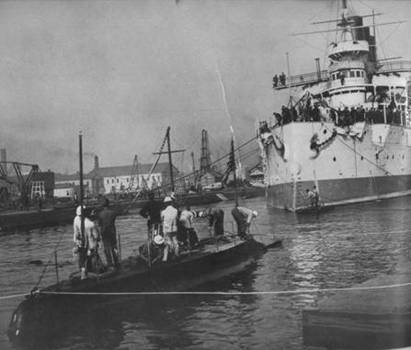
The tiny Holland, designed by the American inventor John P. Holland, was launched in 1898. It was
the first submarine purchased for the United States Navy. This unusual photograph
shows the Holland and the Russian battleship Retvizan entering the drydock at the New York Navy Yard. The Retvizan was later sunk in the Russo-Japan war. [circa 1902] |
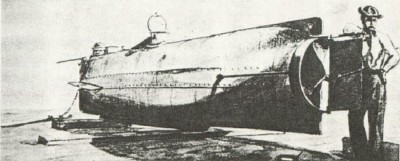
The Hunley had a lot of similar features to that of the Turtle. Similar and improved.
Both may look crude and thrown together but they were well engineered machines.
A lot of work and ingeneous design went into these ancestors of todays subs. |
Above is Bushnell's Turtle about 1776 Below is Horace L. Hunley's sub H L Hunley in 1864. |
There are many more on the sub and it's recovery operation. Just type Hunley in your
search |
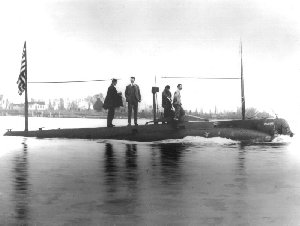
At Right and above is the Holland |
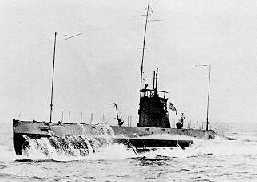
Below is a K class submarine. K class were put into commission about 1914. |
100 years of Destroyers |
1902 - 2002 |
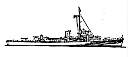
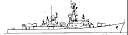
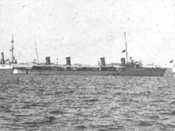
Bainbridge DD1 US Navy's first destroyer |
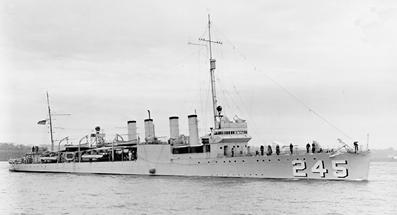
Rueben James DD 245 Commissioned Sept. 20, 1920 was sunk by a German U boat U 552
South of Iceland Oct. 31, 1941,before the US entered the war. The US Navy
was in an undeclared war long before the Japs bombed Pearl Harbor. 115 men were
lost and remain on duty |
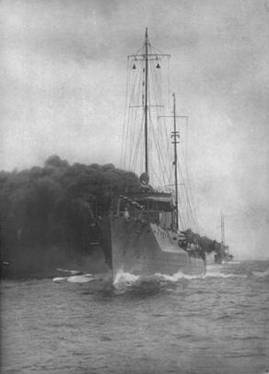
At right one of the destroyers duties in those early days were laying of smoke screens
to protect the main fleet. This tactic was made obsolete with the invention
of radar. |
After WW II tin cans would prove their worth time and time again. During the Korean
War destroyers were at the front of the action again doing gunfire support missions
at Inchon and running mine fields to get closer to targets to help clear
the way for our boys to land. The threat of the spread of Communism threatened the free worlds way of life. The Soviet communists quickly started taking small countries after WW II and took half of Germany and Berlin and devided the world again. This time with an Iron Curtain. In 1948 they put a blackade on all roads and rail lines from West Germany to Berlin in an effort to strangle West Berlin into submission to Soviet rule and domination. Our Air Force worked around the clock in an unprecidented airlift to keep supplies going in. The Russian attempt failed. This was the beginning years of the longest war the US has ever fought. The Cold War. New and ships like New would be at the forefront of keeping the world free. A new type of soldier and sailor came on the scene. The Cold Warrier. From almost the beginning of New's life she was in the midst of this cold war. Growing threats from Russian air, sea and land forces made the neccesity for newer and better weapons developemt. New would undergo many changes thru the years and so would her role. Veteran destroyers would get old weapos removed and new ones added and updated electronic equipment. It was a fast changing time. Long range high altitude bombers that could fly across the Atlantic became a reality. Some DD's and DE's were refitted with air survielance radar and sent to patrol the oceans farther off the coast. This was the redisgnation of the DDR and DER, Radar Picket Destroyer. New was refitted with new radar, better sonar and more modern Anti Submarine weapons and redsignated as DDE. New;s main duty now was Anti Submarine Warefare. At the close of WW II the Germans had developed a new generation of submarine. Fortunately they didn't get a chance to produce many. The Russians were quick to use this technoligy to design and build newer subs that could go farther and dive deeper and move faster below the surface. The new subs were quieter than the old generation. Torpedoes were smaller and faster and more deadly too. The US had designed and continued to work on better ASW methods and weapons. We met the challenge. We countered the threat. K Guns soon gave way to Hedge Hogs and Weapon Alfa which was a rocket propelled charge that was shot from a Buck Rogers looking gun mounted on the O1 level forward of the bridge and out to the area where the sub was suspected to be. The hedge hog was shot from a rack like a dozen morters and formed a circle pattern around the target position. The depth charge was still used well into the sixties but was fairly obsolete before 1955. A new torpedo system was devloped that could electronicaly hone in on a target, track it down and kill it. Then came the ASROC. The Anti Submarine Rocket. This became the most effective weapon against the quickly changing submarine technoligy. It was fast, could be shot out at a long range and hone in on the target. Most effective against the new Nuclear sub which was fast, quiet and could stay under indefinately. Unlike the diesel boats the nuke didn't have to surface to recharge batteries. Another good weapon used against subs were aircraft. Early on in WW II they were used to hunt Uboats from the air. Subs could be seen easily from the air and planes could drop depth charge bombs over the target or direct a destroyer to the target. During the Korean War helicopters proved their worth in rescue and evacuation of land troops. The navy was using them for picking up downed pilots at sea. At first their use was limited mostly by the technoligy. Newer and better designes soon widened the rols of helo and they were eventually used for ASW. New was put into the shipyard in 1963-64 for an extensive rebuild. It would come out an entirely different ship from the main deck up. A new and larger CIC, (Combat Information Center) Sonar would be moved to CIC in a separate room in the back. The bridge would be much larger. New would have onlyy two main 5 inch duel gun mounts and all 40MM guns were removed. No more depth charges.A hanger was installed with a helo deck . Midship a large box on a revolving pedistol was placed. This was ASROC. New's helo deck was a little bit small for a manned chopper to land but it was designed for a small unmanned drone helo. This DASH, Drone Anti Submarine Helo could carry two torpedoes out several miles over the target and dropped and then return. It was manned by remote control. As destroyers were designed larger they were able to use manned helo's. Gearings, tho large for a DD in 1945 was dwarfed by DD's and DDG's and the new DLG's. |