
These photos sent in by Rich Bashlor and Don Smith. Life was a bit cramped when at
sea. It was cramped when in port but at sea all hands were on board and needed
to be fed three times a day and the mid watch got fed mid rats, ( mid nite rations
not varmits). The watch stations in the engine and boiler rooms, on the bridge,
CIC, signal bridge, after steering and lookouts as well as many other stations
had to be manned around the clock. The messdecks were small but the crew
was fed in less than two hours. The racks (bunks) were close together but we slept
sound until the GQ alarm was sounded. Then in only a few minutes we were up,
dressed and rushing to the battle sations. In the Med and other places GQ was
a drill and usually held in the day. During the West Pac it was no drill when
inside the war zone and knew no time barriers. From a sound sleep in an instant
we would be up and ready as soon as the speaker came on, the boatswain pipe blew
and the announcement came. There was time to relax, time to sleep as well as
time to do our work stations and stand watches. These pictures will give
someone who has never seen inside a US Navy destroyer a glimpse of life. It will
give others a bit of memory that may have faded over the years. |
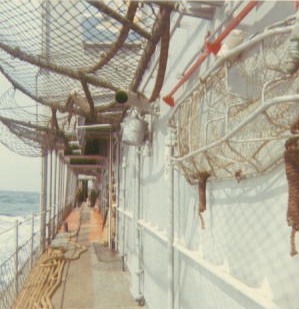
Port side aft by the DASH deck on main deck looking forward notice safety nets overhead
for the DASH deck. Red areas on the deck are the red lead paint used as
a primer before the deck gray went down. Painting was a constant thing on these
ships. |
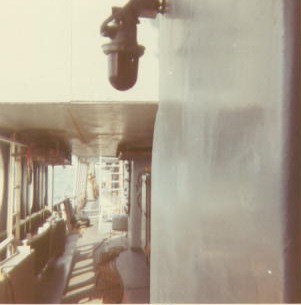
Main deck, starboard side forward by the weather break looking aft. |
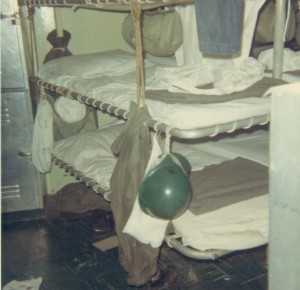
Above and below shows crews quarters as they looked when at sea. Racks were canvas
strung on the metal aluminum tubing. They periodically needed tightning of the
line and sometimes replaced. Other wise the guy below would lose some sleeping
space. Things in the berthing compartment were tight as it was. |
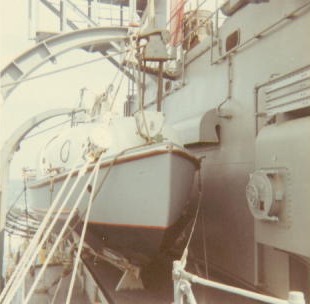
The NEW Boat as it was called. Ships Motor Whale Boat. MWB |
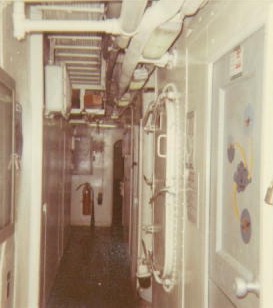
This passegeway on the first deck ran forward from the messdecks to the CPO quarters.
There were 2, ( as I remember) officers staterooms on the right, a crews head
on the left as well as some storage areas and small fan and equipment rooms.
|
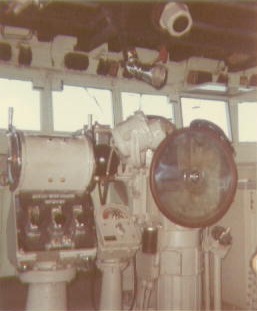
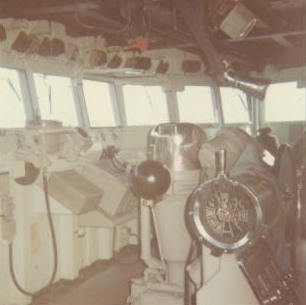
Views of the Bridge showing the Lee Helm, Wheel, compass and other instruments. The
bridge had radar repeaters, ship intercom and sound powered phones. It also
had radio communications patched up from the radio room. It could be a busy place
at times. |
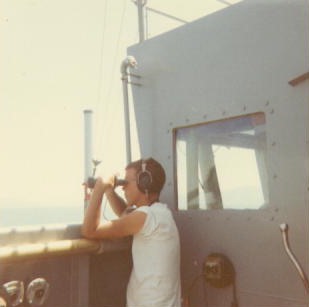
Above a lookout on watch on the port wing of the bridge deck. Looking thru binochulars
he is wearing a set of sound powered phones to communicate with other lookouts,
the bridge and CIC. Lookouts are extremely important when a ship is underway.
Around the clock lookouts search the sea and horizon for anything. Ships,
planes. They are also on the alert for man overboard. This young seaman looks
comfortable in a T shirt. In cold weather they are still outside and it does get
cold too. Peacoats and longjohns don't seem enough in cold weather. At sea in winter the air
is rather raw at best. |
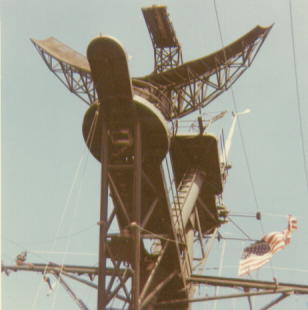
A view of the mast. Note yard arms where signal flags were raised. Old Glory flying.
The US flag was raised here as soon as the ship was underway and flew from
the mast until the word moored was passed. At which time it was hauled down and
the flag raised on the fantail with the jack on the foc'sle. The semi round antenna
is the SPS 40 air search radar antenna. It had a long range to pick up aircraft
at ranges of 200 miles or more if needed. On a higher platform is the SPS
10 surface search which was a shorter range radar. |
In and around the ship |